
Your GPS tells you where the money goes. AI video tells you why — and stops it.
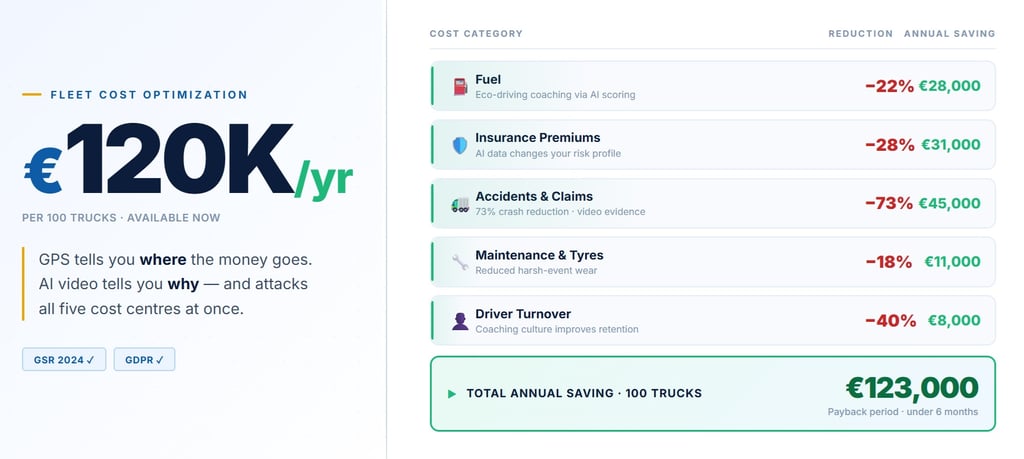
GPS tracking told you where your drivers were. AI video telematics tells you how they drive — and that difference is worth €1,200 per truck, per year, across five cost categories most fleet managers are still measuring separately.
4/9/20268 min read
Your GPS tells you where the money goes. AI video tells you why — and stops it.
The €120,000 Optimization Gap Hidden in Every 100-Truck Fleet
Every fleet manager in the Baltics and Nordics knows their fuel bill. They know their insurance premium. They know — roughly — what a bad month of accidents costs. What almost no one knows is the total, because no one has been adding it up.
GPS telematics solved the location problem a decade ago. It told you that a truck departed Riga at 07:14 and arrived in Vilnius at 13:30. What it could not tell you was that the driver used his phone for 23 minutes between junctions, braked harshly eleven times, and idled for 87 minutes at a rest stop — generating costs that never appear on a single invoice but collectively dwarf the GPS subscription fee.
That is the optimization gap. AI video telematics closes it. Not by adding another tracking layer on top of what you already have, but by providing the why behind every cost line in your operation. Here is what that looks like across the five largest variable cost centers in a commercial fleet.
GPS tracking told you where your drivers were. AI video telematics tells you how they drive — and that difference is worth €1,200 per truck, per year, across five cost categories most fleet managers are still measuring separately.
Fuel costs via eco-driving coaching
-22%
↓ €28,000/yr
-28%
-73%
-18%
-40%
Insurance premiums with AI data
Preventable crash rate (Samsara)
Maintenance costs via wear reduction
Driver turnover with coaching culture
↓ €31,000/yr
↓ €45,000/yr
↓ €11,000/yr
↓ €8,000/yr
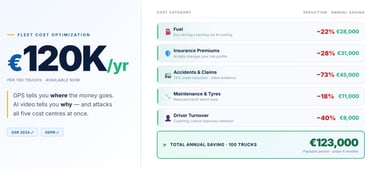
Total estimated annual saving: €123,000 per 100 trucks
of commercial fuel spend is wasted by sub-optimal driving behaviour (Fleet Europe, 2025)
34%
of fleets using AI dashcams report positive ROI within 12 months (industry composite)
average daily idle time per commercial truck — each idle hour burns €2–4 in fuel
86%
4.5 hrs
Fuel — Your Largest Variable Cost, and the Easiest to Move
Estimated saving: €28,000/year per 100 trucks
Fuel is typically 30–35% of total fleet operating cost. It is also the cost most directly tied to driver behaviour — a factor that is invisible without in-cab video.
Aggressive acceleration increases fuel consumption by 15–20%. Excessive speed above 85 km/h increases consumption by a further 8–12% for heavy trucks. Idling burns 1.5–2 litres per hour with zero productive output. A truck that idles 90 minutes per day wastes approximately €1,800 in fuel annually at current diesel prices.
When AI platform scores each driver's trip — flagging harsh acceleration events, prolonged idling, and excessive speed — fleet managers can intervene with coaching before the next quarter's fuel invoice arrives. Fleets that implement structured eco-driving programmes using AI video data consistently achieve 15–22% fuel reduction within 90 days. For a 100-truck fleet spending €560,000 annually on fuel, that is €84,000–123,000 per year — from behaviour alone, with no route changes and no new hardware beyond the dashcam.
Conservative 100-truck annual fuel saving at 5% improvement — fleet-level eco-driving coaching,
based on €560,000 average annual fuel spend for 100 HGVs in Baltic/Nordic markets.
€28K
1
Insurance Premiums — The Cost That Compounds Every Year You Don't Act
Estimated saving: €31,000/year per 100 trucks
Commercial fleet insurance in Latvia, Lithuania and Estonia has risen 15–25% in the past three years. The increase is driven by claims frequency, claims severity, and fraud. All three are directly addressable with AI video data.
Insurance companies are beginning to price AI dashcam deployments into their premium models. Fleets that can demonstrate verified driver behaviour data, event-triggered recording, and a documented coaching programme are presenting underwriters with a materially different risk profile than fleets that cannot. The premium difference is 20–30% and growing.
This is not a future development. AXA XL research shows that fleet drivers enrolled in AI dashcam-based feedback programmes are involved in incidents that are 60% less likely to occur and 86% less expensive to resolve. Insurers price risk based on data they have. Give them better data, and they will price it better.
Additionally, when incidents do occur, video evidence reduces the "at fault" determination against your fleet. Industry data shows that 63% of disputed incidents are resolved in the fleet's favour when road-facing camera footage is available — directly reducing the incident costs that flow into next year's premium renewal.
20% premium reduction on a €155,000 annual insurance spend for 100 trucks —
achievable 12–18 months after AI dashcam deployment and driver programme documentation.
€31K
2
Fleets using AI dashcams with structured driver coaching achieved a 73% crash rate reduction over 30 months. The impact on premium renewals is a different kind of return — one that compounds every year the programme runs.
— Samsara 2025 Fleet Safety Report · 2,600 fleets · 20 trillion data points · 30 months
Accident & Claims Costs — The Most Visible Saving, and the Easiest to Quantify
Estimated saving: €45,000/year per 100 trucks
A fully-costed accident — including legal fees, driver downtime, vehicle off-road time, administrative hours, and claim settlement — runs to €15,000–50,000 per incident. A 100-truck fleet in normal Baltic/Nordic operating conditions experiences 8–12 recordable incidents per year. Two or three of those will become disputed claims.
The AI safety layer addresses both sides of this cost: prevention and resolution.
Prevention: ADAS features — forward collision warning, lane departure, following distance alerts — actively intervene before an incident occurs. DMS features — fatigue detection, phone use detection, distraction monitoring — address the human factors behind 90% of road incidents. Fleets that deploy both and follow up with driver coaching achieve the 73% crash rate reduction documented in the Samsara 2025 data.
Resolution: When incidents do occur, video evidence changes the legal and insurance outcome entirely. Claims with dashcam footage settle in 48–72 hours. Claims without video take 3–5 months and settle, on average, at 4–8× the cost. The camera does not just prevent accidents — it prevents the €50,000 downstream cost of a single accident that cannot be resolved with evidence.
Avoiding 1 disputed claim per year (conservative estimate) and reducing incident frequency by 30% —
for a 100-truck fleet with baseline accident rate of 10 events/year.
€45K
3
Maintenance & Tyre Costs — Invisible Until the Invoice Arrives
Estimated saving: €11,000/year per 100 trucks
Aggressive driving destroys vehicles slowly and expensively. Harsh braking degrades brake pads 30–40% faster than smooth driving. Harsh cornering and acceleration accelerate tyre wear by 20–25%. Engine over-revving shortens service intervals.
None of this appears on a single cost line. It accumulates across monthly maintenance invoices, unplanned breakdowns, and annual tyre replacement schedules. Fleet managers who review these costs in aggregate — and then trace them to driver behaviour via AI video scoring — consistently find that 20–30% of their maintenance spend is attributable to identifiable driving habits in a subset of their driver pool.
The AI platform generates a daily driver score that includes harsh event frequency per kilometre — the single metric most predictive of maintenance cost. A driver who scores in the bottom quartile on this metric generates, on average, 2.1× the maintenance cost of a top-quartile driver on an equivalent route. Correcting that gap through coaching does not require a confrontation — the driver sees their own data, compares it to fleet peers, and adjusts. The behaviour change is typically visible within two weeks.
15% maintenance cost reduction for a 100-truck fleet spending €75,000/year on tyres and scheduled maintenance —
achieved through harsh-event-based coaching targeting the bottom 20% of drivers by score.
€11K
4
Driver Retention — The HR Cost That Never Appears on a Safety Report
Estimated saving: €8,000/year per 100 trucks
Replacing a commercial driver costs €3,000–5,000 in recruitment, onboarding, and productivity loss during the transition period. Annual driver turnover in Baltic and Nordic commercial fleets runs at 18–25%. For a 100-truck fleet, that is 18–25 replacement cycles per year — a €54,000–125,000 cost that almost never appears in a fleet safety discussion.
The connection to video telematics is indirect but consistent: fleets that implement coaching programmes built on AI video data see driver retention improve. The reason is counterintuitive. Drivers initially resist camera monitoring. Once they see that the data is used for coaching rather than punishment — and particularly once it protects them from false blame in disputed incidents — their relationship with the system inverts. Being able to prove you were not at fault in an accident is, for professional drivers, a career-protecting tool. Drivers who have been exonerated by dashcam footage rarely leave the fleet that protected them.
Additionally, structured coaching identifies top performers and gives fleet managers an objective basis for driver recognition, route assignment, and performance bonuses — tools that meaningfully improve retention without requiring salary increases.
2 fewer driver replacements per year (on a 22% turnover rate, 100 trucks) at €4,000 average replacement cost —
achievable within 12 months of a structured driver coaching programme.
€8K
5
The Total Picture: What All Five Savings Look Like Together
Fleet managers typically evaluate these cost categories separately, with different people responsible for each — operations for fuel, HR for turnover, insurance managers for premiums, workshop managers for maintenance, and safety officers for accidents. No single person sees the compound effect.
AI video telematics is the first technology that closes all five simultaneously, because the underlying data source — video-verified driver behaviour — is the common cause behind all five cost lines.
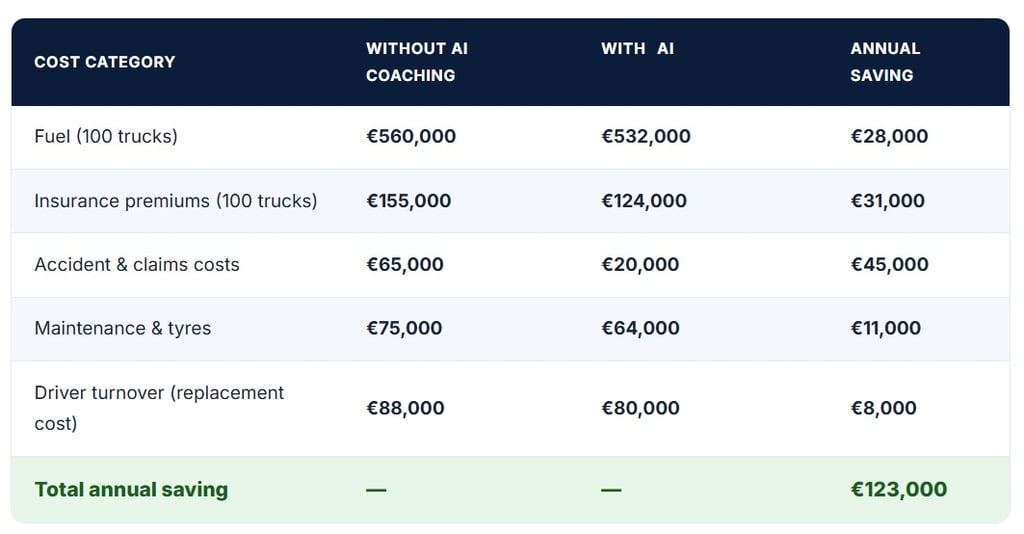
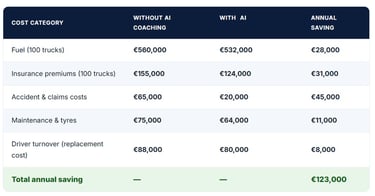
Note on the numbers: All figures above are estimates based on industry benchmarks and fleet safety research. Your fleet's actual savings will vary depending on current driver behaviour, route profile, incident history, and insurance structure. The SafeFleetView pilot programme is specifically designed to generate your own fleet's baseline data — so you can calculate your precise ROI before committing to full deployment.
Why GPS Alone Cannot Close This Gap
GPS telematics systems have been standard in commercial fleets for over a decade. They are excellent at what they do: location tracking, route logging, geofencing, arrival time reporting. But they measure outcomes, not causes.
GPS tells you a truck was late. It cannot tell you the driver spent 20 minutes on the phone before the motorway junction. GPS tells you fuel consumption per route. It cannot tell you the driver was harsh-braking through every roundabout. GPS tells you a vehicle was stopped for 40 minutes. It cannot tell you whether the engine was running.
AI video telematics adds the causal layer. The dashcam sees what the GPS cannot: driver behaviour, in real time, with AI classification of every event that matters. The integration between GPS location data and video event data — which SafeFleetView delivers through the FleetLive platform — means fleet managers are no longer correlating data from two separate systems. They see route + behaviour + cost driver in a single interface.
AI Platform — What It Optimizes
Daily driver eco-score + harsh event frequency per km (fuel & maintenance)
Idle time tracking and alerts per vehicle (fuel)
ADAS event log — FCW, LDW, tailgating, pedestrian (accident prevention)
DMS event log — phone use, fatigue, distraction, seatbelt (accident prevention)
Incident video clips — timestamped, GPS-tagged, GDPR-compliant (claims resolution)
Fleet-level trend reports — 30/60/90 day coaching effectiveness data (insurance)
Driver ranking and peer comparison (retention and coaching culture)
Automatic ADAS alert within 48 hours of installation

The Optimization Starts on Day One
The most common hesitation we hear from fleet managers is not budget — it is time. "We don't have the capacity to manage a new system." "My drivers won't accept cameras."
Both concerns dissolve within a week of the pilot. The platform requires no new daily workflow — it surfaces exceptions rather than asking managers to watch footage. You get a driver score dashboard, a weekly top/bottom performers list, and alerts when events exceed your threshold. The system does the analysis; the manager makes a three-minute coaching call.
As for driver acceptance: in every pilot we have run, the inflection point comes when a driver is exonerated by dashcam footage from a false claim. After that, cameras are not surveillance. They are professional insurance.
Sources & Methodology
① Samsara — 2025 Fleet Safety Report · 2,600 fleets, 30 months, 20 trillion data points · 73% crash rate reduction figure
② Fleet Europe — Fleet Management Benchmark Report 2025 · fuel waste percentage from driver behaviour analysis
③ AXA XL — Fleet telematics and AI dashcam impact study · incidents 60% less likely, 86% less expensive with AI feedback programmes
④ Lytx — 2025 Road Safety Report · driver behaviour, coaching impact, and fleet risk modelling
⑤ ETSC — European Transport Safety Council: Fleet Safety Benchmarks 2024 · accident cost methodology
⑥ Baltic/Nordic fleet cost estimates based on industry composite data for diesel prices, insurance rates, and maintenance spend in LV/LT/EE/FI markets (2025–2026). Actual results vary by fleet profile.
Subscribe to our latest news
Contact
Smart Technology for Fleets and Cities
Phone
sales@ecotelematics.com
+358 405 189 190
© 2026 EcoTelematics Group Oy. All rights reserved.